
 Add to Chrome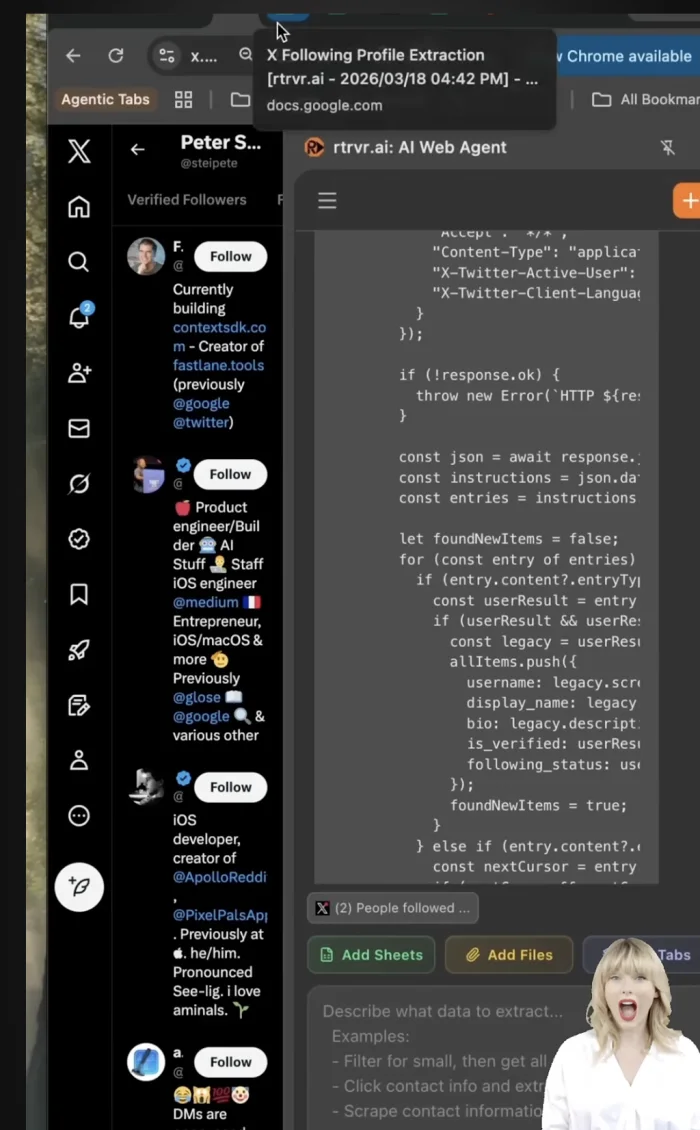

The big unlock behind modern scraping is simple: most websites are wrappers around APIs.
That means the fastest path to structured data is often not clicking through every page like a human. It is using the page to uncover the network layer the site already depends on, then turning that discovery into a repeatable extraction workflow.
That is what we mean by Vibe Hacking.
This launch brings three things together:
- Vibe Hacking for reverse-engineering site APIs and scaling extraction
- Rover as an open layer for turning any web interface into an agentic surface
- Gemini Flash Lite as the default for lightweight daily-driving tasks
Websites Are Wrappers for APIs
The UI is usually the last mile, not the source of truth.
Buttons trigger GraphQL mutations. Search bars call JSON endpoints. Infinite scroll is often just paginated XHR. Filters, product grids, dashboards, and feeds usually sit on top of structured APIs that are easier to reason about than brittle visual selectors.
The critical insight is that once an agent can interact with a page, it can also observe the network calls that page makes. At that point, the website stops looking like an opaque interface and starts looking like an executable API map.
For scraping, that changes the game:
- You get cleaner structured data than DOM-only parsing
- You reduce the number of page interactions needed to collect large datasets
- You can convert one successful browser session into a repeatable extraction script
How Vibe Hacking Works
Vibe Hacking starts with the same thing users already do: open a page and ask the agent to accomplish something.
The difference is what happens under the hood:
- The agent takes actions on the page to reach the relevant state.
- It watches the page's network activity and uncovers the underlying APIs.
- It identifies useful request patterns like GraphQL operations, REST endpoints, cursors, filters, and auth-bound headers.
- It writes a script that can replay the useful calls and extract the data at scale.
In practice, this means the agent can click into the right view, discover the network calls behind it, and then graduate from "one successful run" to "here is the script that can pull the next 10,000 rows."
This is especially valuable on sites where the visual UI is noisy but the underlying data layer is clean.
Why Code Execution + Browser Context Matter
From the very beginning, we believed in the power of code execution. The first version of rtrvr already shipped with the ability to execute LLM-generated code, because we thought agents would eventually need to do more than click around the web. They would need to inspect, transform, and run real logic.
This release ties that early bet directly to the browser-authenticated context.
The reason raw HTTP scraping has not taken off for most people is that two hard problems usually show up at once:
- Reverse-engineering the actual site endpoints
- Recreating the authorization and header logic that made those requests work
Vibe Hacking closes both gaps in one flow. The agent discovers the useful endpoints from the live page, then the extension executes requests from within the webpage context so the relevant headers and authorizations propagate automatically.
That gives you the strongest anti-bot footing available without hand-rebuilding the site's auth stack from scratch. It is not magic, and sites still control their own defenses, but it is materially better than detached scraping setups that try to guess how the browser was authenticated after the fact.
More importantly, it democratizes this workflow. You no longer need to be the person who manually reverse-engineers a site's request graph and rebuilds the auth logic by hand. You can do it directly in your browser.
Roadmap: Reusable Scripts, Cloud Scale, and Enrichment
This launch is the starting point, not the ceiling.
Next up:
- Cloud execution for repeatable scale so successful reverse-engineered workflows can run beyond a single local session
- Reusable network scripts as tools so the best extraction logic can be saved, parameterized, and reused
- Hybrid scripts that combine network calls with DOM parsing when the best result needs both layers
- BrightData-powered enrichment recommendations so after a scrape the agent can suggest the highest-value datasets to join onto what you collected
Long term, the goal is to build the best vibe scraping harness and then layer enrichment and downstream value-adds directly on top.
Rover: Turn Any Web Interface Agentic
At the same time, Rover is becoming the open layer for turning web interfaces into agentic surfaces.
Rover now installs through Workspace and the hosted runtime at rover.rtrvr.ai/workspace.
That means you can integrate it with your own browser automation stack, Chrome extensions or Electron apps, and turn any web interface into an agentic surface.
Rover can also integrate with our cloud browser infrastructure for cross-domain interactions where the agent needs to gather context in one place and take action in another.
In the demo flow, Rover looked up a menu URL in a cloud browser and then updated menu items in Grab. That is exactly the kind of cross-surface workflow we want Rover to make normal.
Rover Cross-Domain Demo
Watch Rover use cloud browser context to look up a menu URL and update menu items in Grab.
Where this goes next:
- Partnerships in progress with enterprises and website builders so you will see more of Rover on the web
- Voice integration so websites can offer an accessibility compliance out of the box
- Exposing websites as WebMCP endpoints for other agents to consume
- Indexing site-specific APIs and knowledge bases of page actions
- Recording demonstrations that teach the agent complex workflows
- Expose website to other agents by just opening url with Rover query parameters, no A2A protocols or browser automation needed
We also want Rover to automatically index the actions and APIs exposed by a site. That connects directly to the same network discovery used in Vibe Hacking: discover the site's action surface, model it, and expose it as a surface other agents can use.
The end state is that a site is not just "a website." It is a callable agent surface. In simple cases that can look like opening a URL with a Rover query parameter such as doordash.com/rover_query?=checkout-with-burrito.
Gemini Flash Lite by Default
From the beginning, we made a big bet on building on top of Google.
The reason was straightforward: Google would likely have one of the most optimized inference stacks in the market, even if that also meant product gaps would exist for a while. We cared about the economics and throughput side early because it determines whether web agents feel usable every day or only during demos.
That is why Gemini Flash Lite is now the default for lightweight tasks.
For a large share of daily-driving use cases, you do not need the most expensive model in the stack. You need something fast, cheap, and good enough to keep the loop tight.
The release used Google AI Studio's then-current free tier. Provider limits can change and are separate from Retriever's offer. Today, Retriever includes supported AI in interactive Free Mode without requiring your own API key. Current Free Mode and plans.
Our expectation is that most users should not have to think about model routing at all. Flash Lite should be enough to keep a web agent running every day.
Closing
Vibe Hacking is about treating the web for what it already is: a giant layer of interfaces backed by APIs.
Rover is about making those interfaces agentic.
Gemini Flash Lite as the default is about making the whole system cheap enough to use every day.
If you want to add Rover to a site, start in Rover Workspace.
If you want to try the product, head to the Rover Workspace or learn more at rtrvr.ai/rover.


