I watched Pluribus in one sitting, and one idea would not let go — and it is not the virus.
Everyone knows Carol. Her history, her tastes, what she is going through right now — and she never had to tell anyone. She dials any number and whoever answers has the full context and just does the thing. No ticket, no transfer. Twelve immune holdouts on the planet, each served like the only person on it, because behind every conversation stands the memory of billions.
In the finale, Carlos warns her: "These weirdos have eyes up above. They can read lips from space."
Creepy. Also the service every company promises its customers and none of us delivers.
We do not know our customers
Not for lack of data — we drown in it. We lack one mind. What a company knows about a single customer is shattered across a sales rep, an account manager, a CSM, a support queue, and six dashboards that do not talk. Almost none of it reaches the customer in the moment.
I spent years in post-sales at Google, on Ad Manager's biggest accounts. Know an account cold and you see the problem before the customer finishes describing it. That knowing was the entire value of me — and it walked out of the building every evening in one head.
So companies ration it. Accounts above a line get a person who learns them. Everyone else gets documentation and a form. The hive serves all twelve holdouts because it is billions. You cannot hire billions.
So we built the small version, pointed it at our own website, and measured.
Nine weeks, 15,012 people
Rover is the agent that lives on rtrvr.ai, our own platform. It gives visitors live demos, onboards new customers, answers questions, and does tasks in the real product — a forward-deployed engineer for every account — and it records what it sees. Over nine weeks that came to 15,012 people, 1,583 of whom engaged, and 11,121 typed requests, counted per person rather than per session.
The question: how much of an expert's knowing can be rebuilt from behaviour alone? What follows is the whole method, including the parts that did not work.
Reading a request
Embedding raw transcripts fails. Most of a conversation is greetings, filler, and the agent's own replies — embed that and you get clusters of "hi, thanks, can you help" instead of what anyone actually wanted. Anthropic showed the fix with Clio in 2024: extract first, embed second. A small model reads each session and emits one line of intent. That line gets embedded.
We ran that over every request for roughly the price of lunch. It left 10,484 intent lines, 11.7% of them not in English.
Which clustering method actually wins
Most write-ups assert a choice. We ran the candidates over the identical corpus with identical metrics.
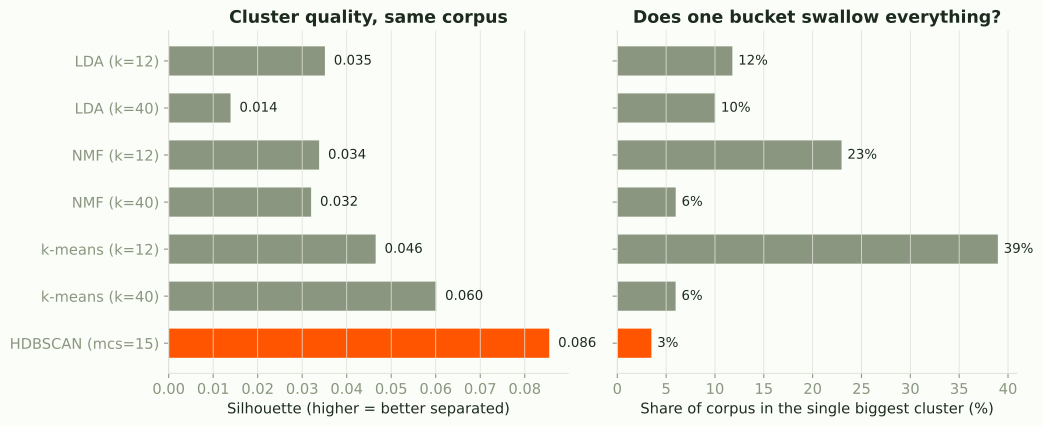
k-means with twelve clusters puts 39% of everything into one bucket. It does so because k-means cannot say this request is not like the others — every point must land somewhere. HDBSCAN's largest cluster holds 3.5%, because it is allowed to leave things out.
It left out a lot: 22.2% unassigned. We kept that number rather than tuning it away. Those are the genuinely one-off requests, and a system that pretends they belong somewhere will confidently mislabel them.
For a buyer, this one chart is the difference between a report that says "your top topic is Support" and one that names 210 specific things your customers tried to do.
The parameter nobody publishes
HDBSCAN has no k, which gets described as "no parameter to guess." That is not true — the guess moves to min_cluster_size.
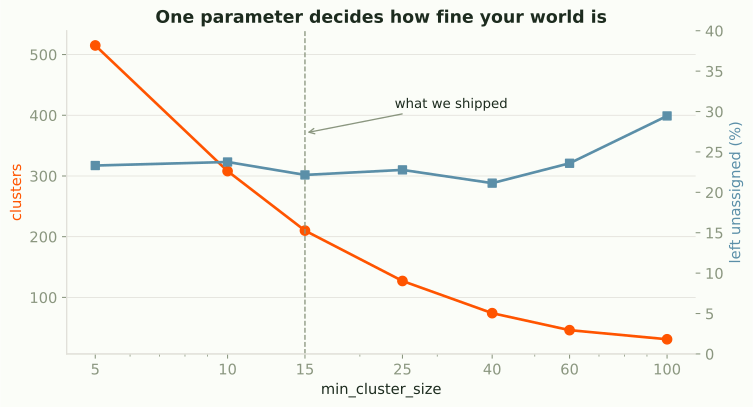
The same corpus yields 515 topics or 31 topics depending on one integer. There is no correct value. We shipped 15 — matching the value Intercom's Fin team published — which gives 210 intents, and we are telling you the number so you can discount it.
The shape of the result matters more than the count:
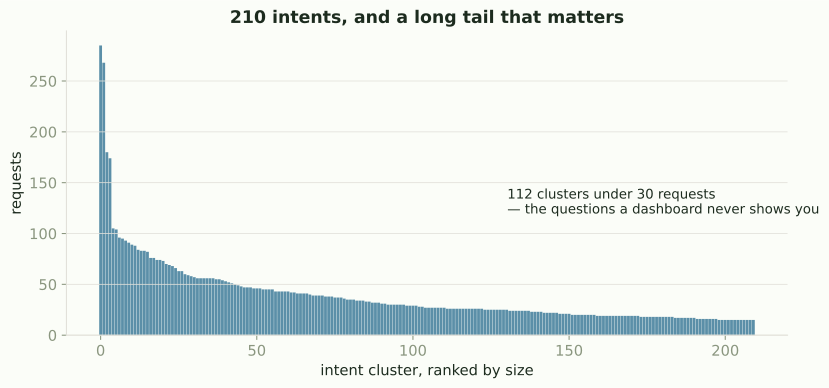
112 of the 210 clusters hold fewer than 30 requests. That tail is the entire point. A dashboard ranked by volume shows you the top ten and hides the other two hundred — which is where the specific, fixable, expensive problems live. Twenty-four people asking to extract job listings is invisible in a monthly rollup and is also a feature request with two dozen signatures.
Is a single point an honest summary?
Production inference keeps one centroid per cluster and assigns new requests by similarity — milliseconds, not minutes. It also quietly assumes clusters are round; if they are stretched or lumpy, the centre sits in empty space and every assignment after it is wrong. So we measured the shape of all 194 measurable clusters.
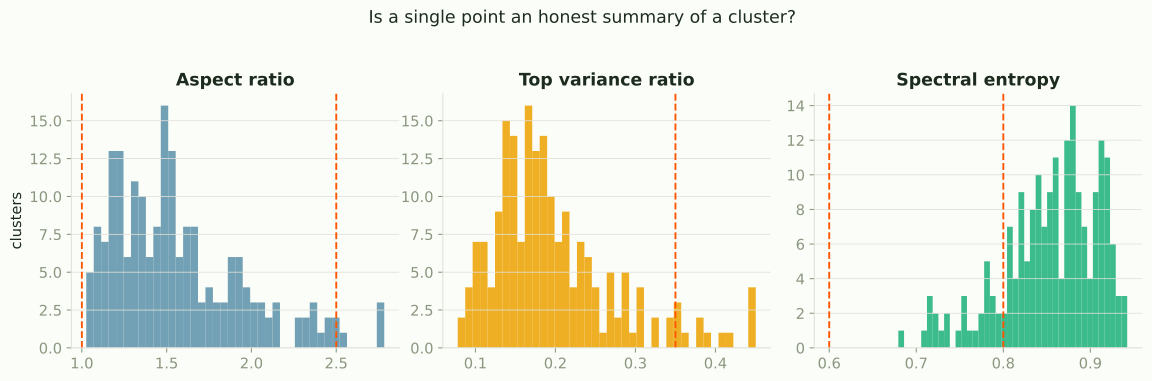
- Aspect ratio: median 1.50, and 97.4% fall between 1 and 2.5. Compact, not stretched.
- Spectral entropy: median 0.862, where 1.0 is a perfect sphere. Fin published 0.6–0.8 on support conversations and called their clusters "egg-shaped rather than round." Ours are rounder.
- Separation 0.82 mean inter-centroid cosine distance, cohesion 0.29 intra-cluster. Fin reported roughly 0.75 and 0.2.
Better separated, slightly looser inside — so centroid inference is defensible in our case, and the fast production path that answers in milliseconds is safe to use.
Then the threshold. Accept an assignment above what similarity?
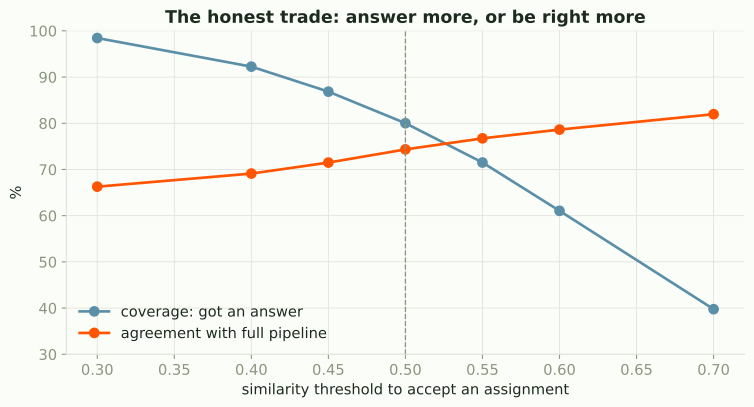
On a held-out 25%, 0.5 gives 80% coverage at 74% agreement. Raising it to 0.7 buys 8 points of agreement and costs 40 points of coverage.
In plain terms: this dial decides whether your agent risks a guess on a new visitor or admits it has not seen this kind of person before. We would rather it admit it — a wrong guess greeted confidently is how trust dies.
Grading the labels — and grading the grader
No ground truth exists here, so the accepted proxy is LLM-as-judge: ask a model whether the assigned label fits. Fin reports over 85% this way. On its own that number is unfalsifiable — an agreeable judge says yes to anything, and the judge literature documents position bias, verbosity bias, and self-preference.
So we ran a control arm: every request judged twice, once against its real label, and once against a deliberately wrong one — a label pulled at random from another cluster. If the judge is just agreeable, it will bless the wrong labels too.
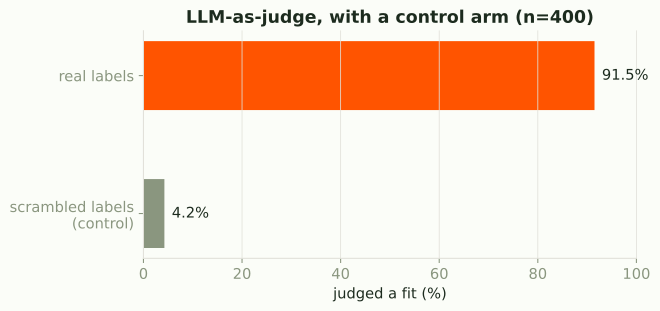
It didn't. 91.5% yes on real labels, 4.2% yes on the wrong ones. That gap is what makes the 91.5% trustworthy — if the judge had blessed even 60% of the wrong labels, our headline number would have been meaningless, and without the control we would never have known. It costs one extra prompt. If a vendor shows you an accuracy number for AI-generated insights, ask what their control was. If there wasn't one, the number is a gut feeling.
The naming model also flagged its own failures: 90.5% of 210 clusters coherent — and the largest cluster in the corpus, 285 requests labelled "YouTube video operations", is one it marked incoherent. Surfaced by the model, not left unnoticed.
Where this pipeline is behind, including ours
The pipeline above is the 2026 production consensus — ours and Intercom's alike. It is also, in three places, behind the research, and it would be dishonest to review only theirs.
The encoder is a 2021 model. all-MiniLM-L6-v2: 384 dimensions, 256-token cap, English-only. Everyone copies the choice. Our corpus is 11.7% non-English, so we tested it.
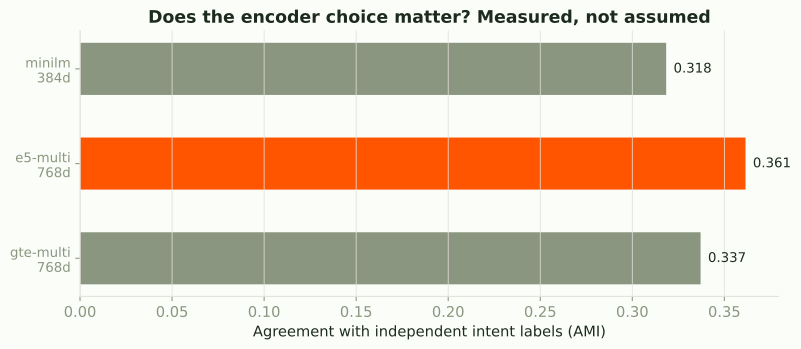
One trap changed the answer: silhouette is not comparable across embedding spaces. Scored that way, MiniLM appeared to win — it has half the dimensions. Scored against an independent label set with adjusted mutual information, multilingual-e5-base beats it by 13.6% relative. This matches MMTEB (ICLR 2025, 250+ languages), whose headline finding is that the best public model is a 560M multilingual one. The upgrade is not "use something bigger." It is "stop using something from 2021."
One honest null: the feared failure where an English-only encoder sweeps non-English requests into a language bucket did not happen — 0.0% for every encoder tested.
The reduction step is the real flaw, and UMAP's own documentation says so. UMAP's docs warn it can "create false tears in clusters, resulting in a finer clustering than is necessarily present in the data" — and everyone clusters on its output anyway. A 2026 IEEE VIS paper, "Stop Misusing t-SNE and UMAP", reviewed 136 papers and found the same misuse throughout. We use the documented clustering configuration (10 components, min_dist=0.0) and treat the projection as a compute shortcut, never as evidence. Matryoshka truncation — reduction trained into the encoder rather than inferred after it — is the upgrade we have not shipped yet.
And the whole shape may be a generation behind. Microsoft's TnT-LLM (KDD 2024) built intent taxonomies for Bing Copilot with no UMAP and no HDBSCAN. Dial-In LLM (EMNLP 2025) works on customer-service dialogue and names embedding-distance reliance as the failure mode. Agentic Clustering (2026) reports up to +32% ARI over the strongest prior LLM baseline — itself an LLM method.
A research post that only lists its own strengths is an ad.
What the clusters actually said
At the top of the 210: company research and data extraction (268 requests), login and authentication (180), web scraping (174), lead prospecting (96), pricing checks (93). Real work, handed to an agent, in plain language.
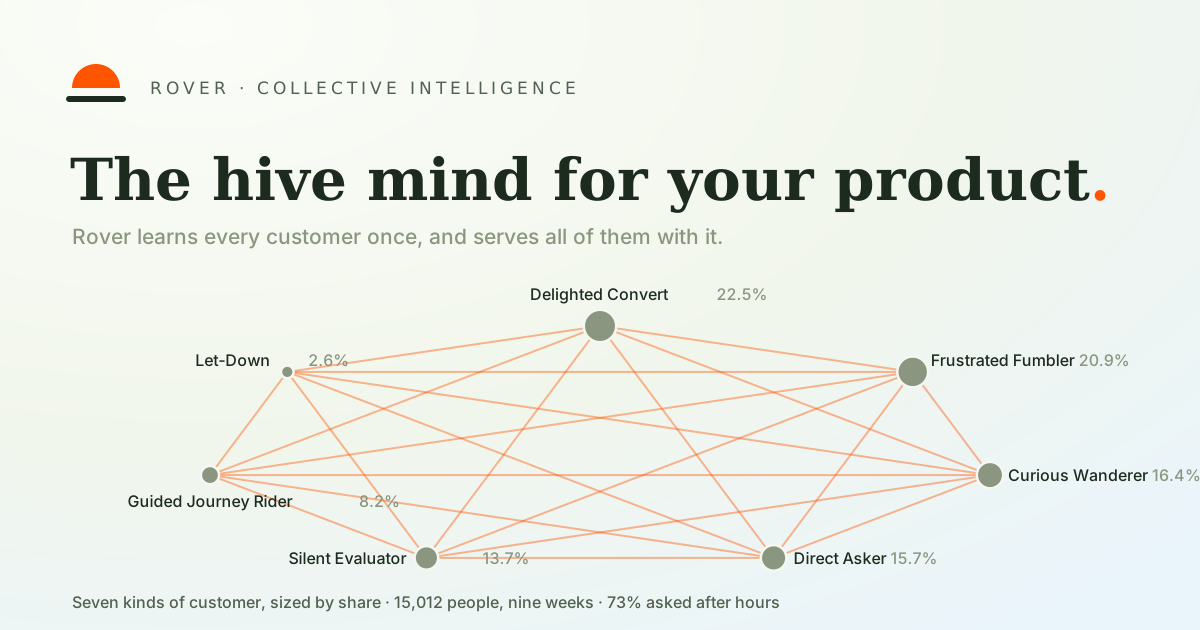
The behavioural half sorts the people rather than the requests — one person, one group, by the strongest signal they showed.
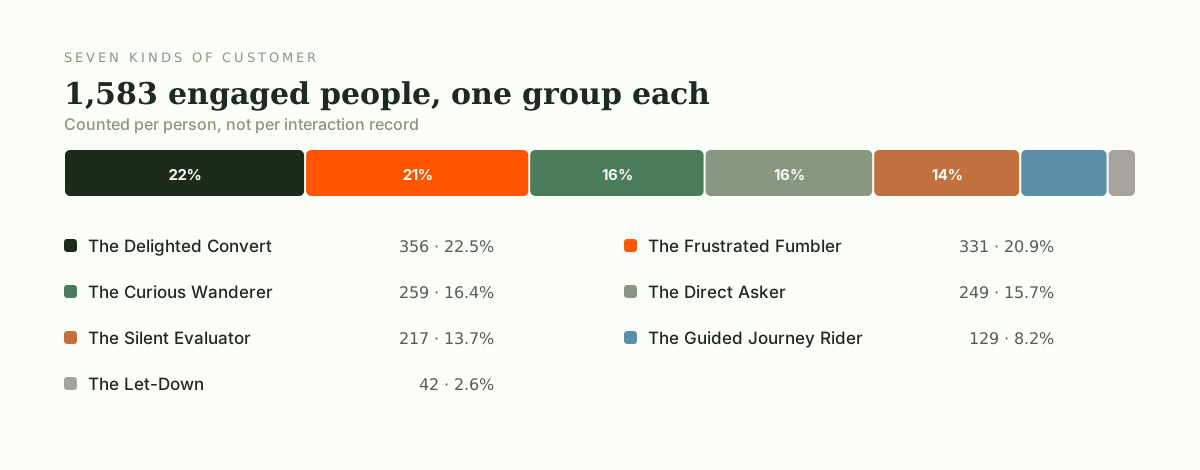
The Delighted Convert — 22.5%. Got what they came for and said so. The largest group, which we did not expect.
The Frustrated Fumbler — 20.9%. Reopened, retried, stalled. Nearly as many as succeeded. "Why is it not letting me sign in."
The Curious Wanderer — 16.4%. Pages of browsing, zero questions, second-best return rate.
The Direct Asker — 15.7%. Typed a real question and expected it handled. "Where are my invoices?"
The Silent Evaluator — 13.7%. Opened, read, left. Almost never came back.
The Guided Journey Rider — 8.2%. Followed an authored flow to the end; best return rate of all. Structure does something an empty text box does not.
The Let-Down — 2.6%. Hit a dead end and said so.
Three findings mattered more than the taxonomy:
43% of engaged people never typed a word. Present and silent — a support queue never learns they existed.
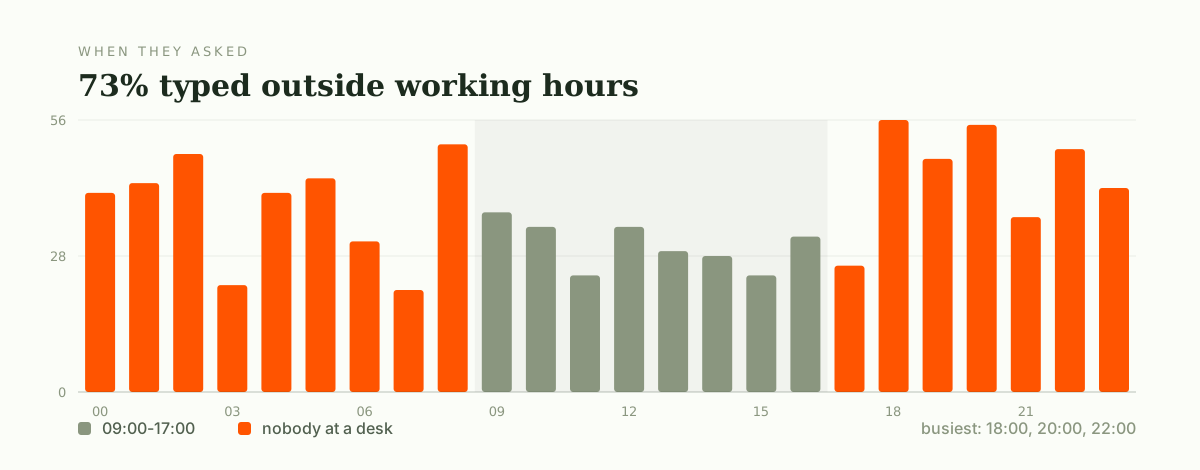
73% of the people who typed did it outside working hours. The 9-to-5 is the quietest stretch of the whole chart — the three busiest hours are 6pm, 8pm and 10pm.
97.6% of requests carried no objection at all. People are not arguing. They are trying to get something done. And when they had to ask, the site had failed them somewhere specific: 128 got stuck partway through a flow, 118 could not find an answer that exists, 107 asked for something the product does not do, 68 could not find pricing.
The half a support pipeline cannot see
Every system in this field clusters text. We have text and behaviour on the same person, which lets us ask a question none of them can: can you tell, from behaviour alone, what a customer is about to ask?
For 651 people we have both. One affinity clears the bar: Guided Journey Riders ask about product specifics and pricing at 3.4× and 4.5× the base rate (n=57, n=16). The people who follow a structured path are the ones evaluating you seriously. The rest of the crosstab runs three to six people per cell — at n=4 it is a story, not a result, so it stays out. Ask us in a quarter.
That join is the structural difference. A ticket topic model sees what was said. An agent that ran the session sees what was said, clicked, stalled and finished, and whether the same person came back — and acts on it in the next sentence, not next quarter's review.
The engineering that makes the acting possible, briefly: Rover operates the real interface by reading the accessibility tree rather than screenshots — one text-only model call where pixel agents burn about a hundred — and runs inside the visitor's own session instead of a remote browser that trips every bot wall. Infrastructure error rate 3.39%, against 20 to 30% for debugger-driven tools. And the same mind answers a public front door where other companies' agents knock: 1,585 distinct AI callers did, in these same nine weeks.
That front door matters more than it looks. McKinsey's work on the automation curve in agentic commerce describes what happens when agents mediate buying: the funnel compresses — search, comparison, and consideration collapse into a single agent-mediated moment — and loyalty turns from sentiment into policy. Advantage moves to sellers that execute reliably against an agent's constraints, away from those best at attracting human attention. That analysis is written about retail. Every line of it reads as B2B's near future. The buyer who arrives as someone else's agent does not admire your landing page; it checks whether you can answer, act, and keep your policies legible — and it re-decides every time.
Eyes up above
Now the uncomfortable part, faced directly.
The oldest fear about hive minds is absorption: somebody's mind stops being their own. Not here. Your customers join nothing — they are strangers who get served like regulars. Your team joins nothing — they stay the individuals the hive hands context to. The only collective mind is the agent's, the one mind involved that was never a person's to lose.
The nearer fear is watching, and the difference between the hive that watches Carol and the hive that serves her is what the knowing is for, and who agreed to it. Our line: identity is hashed in the browser before anything reaches a server; findings are reported for groups above a minimum size, never for individuals; the quotes in this post come from our own properties only. Rover knows your product and what people do in it. It does not follow anyone anywhere else.
Inside that line, "they can read lips from space" reads differently. It is the job your sales, support, and success teams were hired to do and never given the means to: notice everything, remember everything, show up already knowing.
The part that stays human
Carol spends the season searching Zosia's face for the human she knows is not there. She needs one anyway. Customers are the same: the 2.6% who hit a dead end wanted a person, and the ones asking whether they can trust you with their data will always want a person. McKinsey's conclusion about agentic commerce lands in the same place — the future is not maximizing automation but placing autonomy where it enhances experience, economics, and trust, and deliberately preserving the human moments that matter. The hive's job is not to replace your experts. It is to end the rationing — absorb what repeats, learn what each customer needs, and hand your humans the context instead of a ticket number.
Every product gets one
This began as a report we built for ourselves. It is becoming the product. Rover already records this raw material on every site it runs on, and the persona intelligence is rolling into the workspace every customer gets: who showed up, what they wanted, when they were ready, where the product failed them, and what the agent already did about it.
A hive mind for your product — collective intelligence that serves every customer the way your best expert serves your biggest account, works alongside your sales, success, and support teams, and gets better every day. Autonomous employees, on the way to autonomous organizations, starting with the pre-sales and post-sales work that never scaled.
The engine underneath is the number-one-ranked web agent in the world: 81.4% on the Halluminate Web Bench, with the per-category breakdown published, weak spots included.
Frequently asked questions
Is this surveillance?
No, and the distinction is structural. Identity is hashed in the browser before it reaches a server, findings describe groups above a minimum size rather than individuals, and Rover observes only your own product — nothing about a person anywhere else. The knowing exists to serve the person being known, with your site's consent framework governing it.
Did Amplitude and Intercom not already build this?
They built the knowing, and they built it well — automatic clusters, LLM-named topics. In every case we surveyed the output is reporting, and a human carries it to the place where something changes. What has not shipped anywhere we could find is the closed loop: the same agent inducing the persona and acting on it, per person, in the moment.
Does it replace my sales and success teams?
It ends their rationing. Your experts currently cover the accounts big enough to earn them; the agent covers everyone, around the clock, in any language, and hands your team the context when a human is what the moment needs. The 2.6% in our own data who hit a dead end are exactly why the handoff exists.
When does my site get the persona view?
The analytics that feed it ship with every Rover install today. The persona workspace is rolling out to all customers — the same views this post is built from.